Vienna physicists build the first nuclear clock that keeps its own laser in tune
A team from TU Wien and Germany's PTB has built a thorium nuclear clock that stabilizes itself, with a precision equal to an error of about one second in 30 million years. It ran for more than a day on its own.
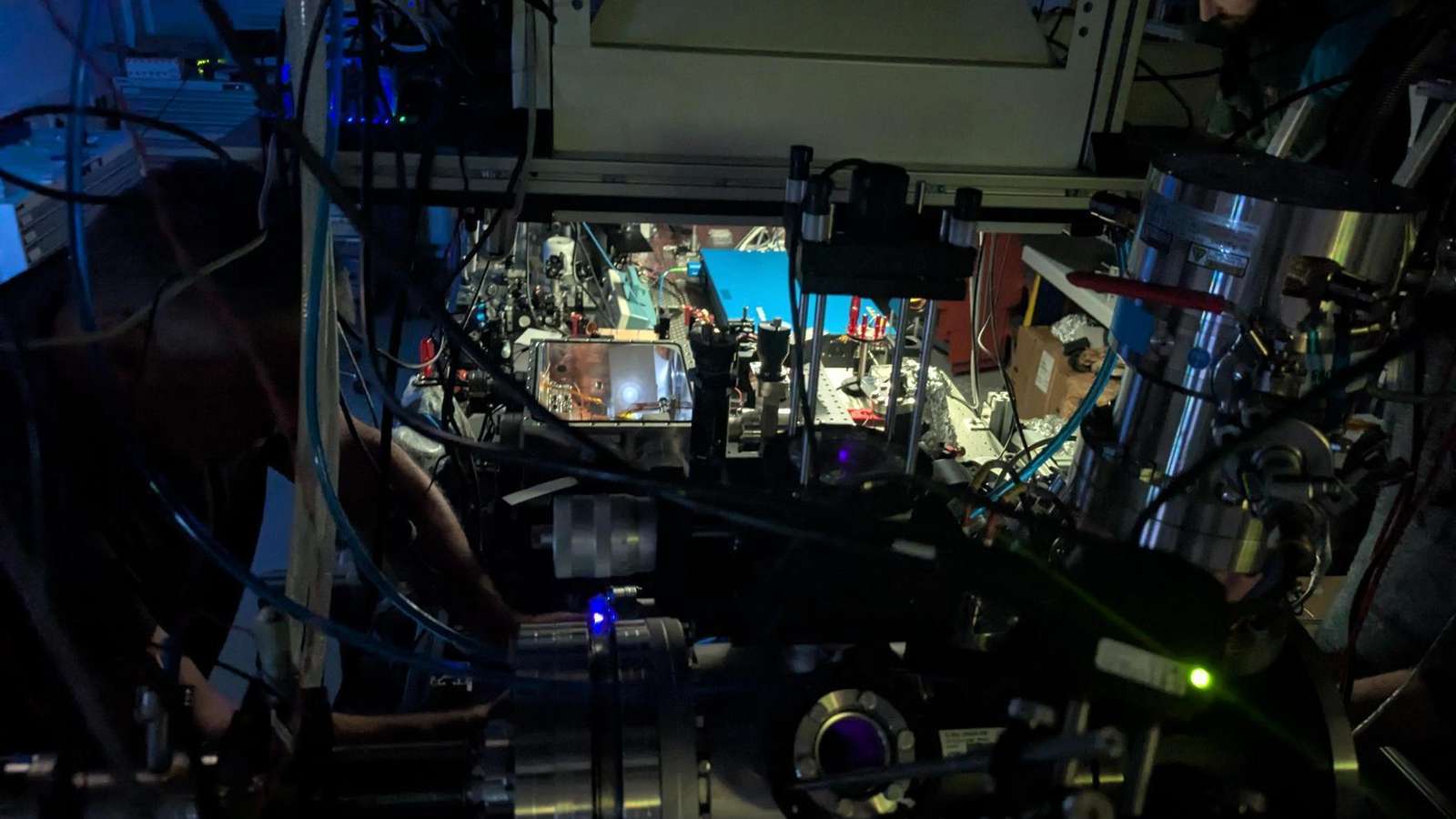
Physicists in Vienna and Braunschweig have built the first nuclear clock that stabilizes itself, using the nuclei of thorium atoms to keep a laser on exactly the right frequency, TU Wien announced on 8 October. Its precision of about 10⁻¹⁵ corresponds to an error of roughly one second in 30 million years. The results appear in Nature.
The prototype ran for more than 24 hours without anyone stepping in. It was built by Thorsten Schumm's group at TU Wien's Institute of Atomic and Subatomic Physics together with Ekkehard Peik's team at the German national metrology institute PTB.
Thorium-229 is the only nucleus a laser can switch
The best clocks today are optical atomic clocks, which count the oscillations of light absorbed by electrons in atoms. A nuclear clock uses the atomic nucleus instead. Nuclei are more than 10,000 times smaller than atoms and react far more weakly to outside disturbances, which is why physicists expect them to make steadier timekeepers in the long run.
Most nuclei have energy levels much too far apart for any laser. Thorium-229 is the exception: it has two states so close together that vacuum-ultraviolet light, at about 148 nanometers, can flip the nucleus from one to the other. The Vienna and Braunschweig teams first showed this in April 2024. In autumn 2024 they linked their thorium setup to a conventional optical atomic clock, but that clock still did the stabilizing.
“What you really want is a self-stabilizing nuclear clock.” — Prof. Thorsten Schumm, Institute of Atomic and Subatomic Physics, TU Wien
The nuclei now correct the laser themselves
At the heart of the new clock is a calcium fluoride crystal containing thorium-229, grown at TU Wien and kept at room temperature. A laser shines on it. When the laser frequency drifts away from the ideal value, for example because of temperature changes, the thorium nuclei absorb less light. The system detects that drop and nudges the laser back, so the clock no longer depends on a separate atomic clock.
"The basic idea is simple: you have a laser and you have thorium," Schumm said. "The laser changes the energy state of the thorium nuclei, and the thorium nuclei are used to stabilize the frequency of the laser."
The researchers also used about 23 hours of data to look for tiny oscillations that some theories of dark matter predict, The Brighter Side of News reported. They found no signal above the detection threshold and used the result to set limits on such effects.
Not yet better than the best atomic clocks
The figure of one second in 30 million years describes the clock's precision measured over one day, not a record. "This is not yet at the level of the world's best optical atomic clocks, but for a first prototype it is a fantastic result," Schumm said. The team plans to improve it with stronger lasers and better thorium crystals.
Precise light sources are a common thread in this field. Chip-sized frequency combs, like the two-laser design from Auckland and Maryland reported earlier this month, are one of the tools used to read out optical clocks.
The Vienna team is not alone. In the same issue of Nature, a research group from China reported building a similar clock, the second group in the world to do so, according to TU Wien. Coverage of the study lists possible uses for future portable nuclear clocks, such as mapping small gravity differences underground, deep-space navigation and testing whether constants of nature change over time.
Sources
- TU Wien · tuwien.at
- thebrighterside.news
How we choose and verify sources: editorial policy.
Like what you're reading?
Related stories
Two-laser design could shrink ultra-precise "light rulers" down to chip size
Researchers in New Zealand and the US have shown a chip-based optical frequency comb, built from two lasers, that performs the key jobs needed for portable atomic clocks and GPS-free navigation.
Australian Team Builds Ultra-Precise Optics to Help LIGO Detect Fainter Gravitational Waves
Researchers at the Australian National University spent three years making two specialized beamsplitters for LIGO, coated to within a nanometre or two across almost half a metre, for an upgrade that will make the detectors more sensitive.
Chinese physicists use the 'empty' vacuum to raise a superconductor's critical temperature by 5.4%
A team at the University of Science and Technology of China placed a thin superconductor inside a terahertz cavity and saw its critical temperature rise by up to 5.4%, the first experimental evidence that vacuum fluctuations can strengthen superconductivity.