MIT's soft sensing sheet copies its own bends and twists in a live 3D model
MIT engineers built a soft silicone sheet with light-carrying rubber fibers that rebuilds its own shape on screen almost in real time. They hope it could one day help physical therapists track patients' movement.
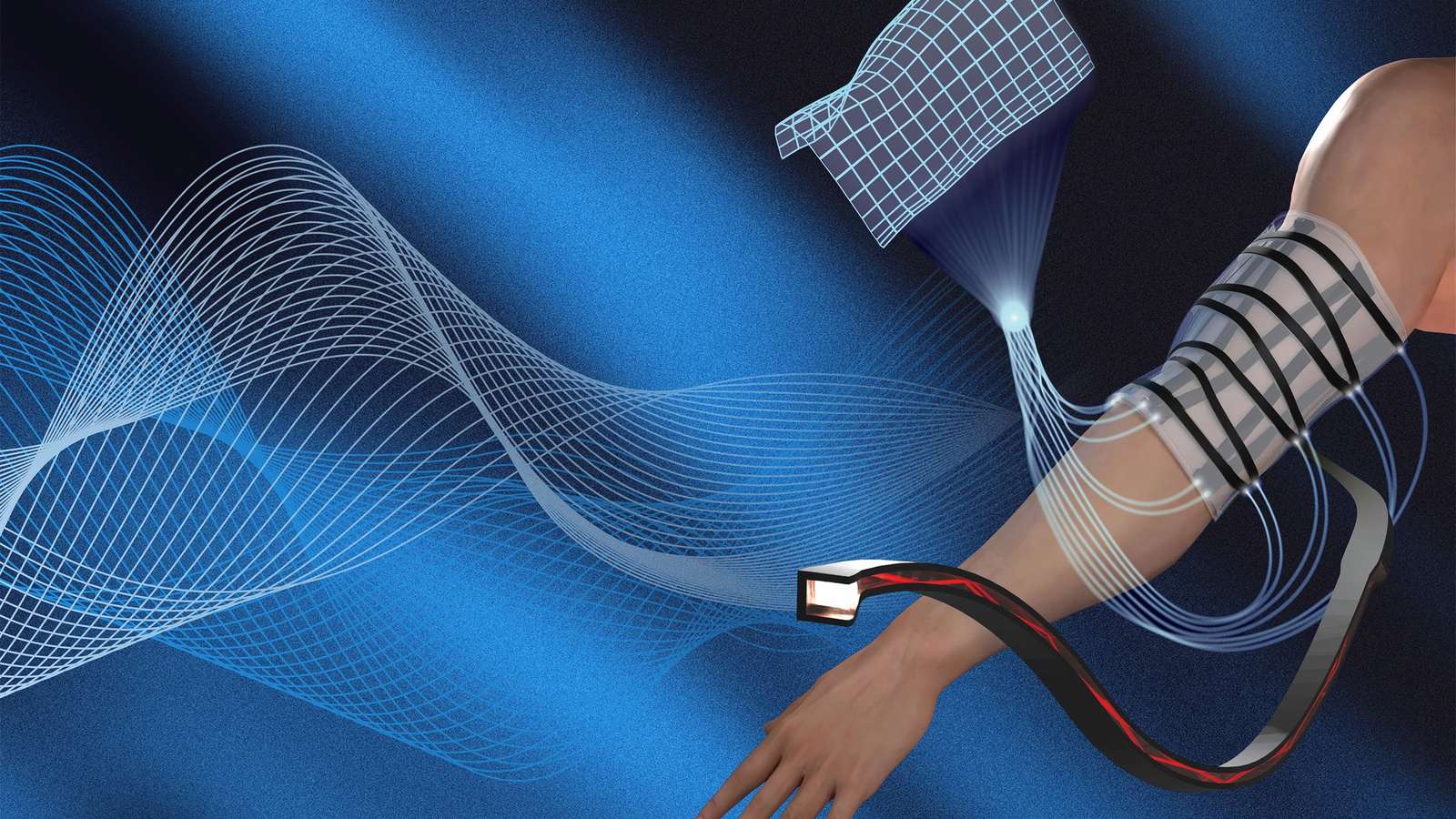
Engineers at MIT have made a soft, flexible sheet that senses its own shape and rebuilds it as a moving 3D model on a computer almost in real time, MIT News reported on 8 October. In tests, the reconstructed surface was off by less than 0.4 centimeters.
The work, led by mechanical engineering graduate student Qifan Yu with Nina Cao and assistant professor Kaitlyn Becker, was published in Advanced Intelligent Systems. Among the uses the team has in mind is physical therapy, where a sheet wrapped around an arm or leg could record how a patient moves.
Rubber fibers that change how light passes through them
The sheet is made of soft silicone with several optical fibers embedded in a zig-zag pattern. Each fiber has a clear, flexible rubber core and a cladding of the same rubber dyed black. An LED shines light in at one end, and a light sensor measures what comes out at the other.
When the sheet bends, the fibers bend too, and the light reaching the sensors changes. One side of each fiber is deliberately roughened, so light scatters differently depending on which way it bends. An algorithm turns the pattern of light readings into a digital model that moves with the real sheet.
The team used simulations to compare layouts from checkerboards to zig-zags before settling on the spacing that best reproduced the simulated shapes. The design is also damage tolerant: with a few fibers cut, the rest can still reconstruct the overall shape.
“Existing designs, which are based on rigid sensors, have errors of around 1 to 2 centimeters. So that's respectable, and at least on par with existing technologies.” — Qifan Yu, graduate student, MIT
A tool for therapists, not yet for patients
The team tested the sheet by folding it diagonally in one direction and then the other, and by draping it over 3D-printed molds of known shape. MIT does not report any tests on people. Physical therapy is presented as a future application.
"In physical therapy, you often need to gather patient data on how they are moving and stretching their arm during rehabilitation, for example," Yu said. "Surface shape sensing could be very useful in that way."
The need is large: about 2.4 billion people worldwide live with a health condition that could benefit from rehabilitation, and in some low- and middle-income countries more than half of those who need it do not get it, according to the World Health Organization.
Becker said the goal is to "build tools that augment what a physical therapist can do and help them track and quantify their patients' progress over time." The sheets, she said, could help a therapist compare more precisely "how an evaluation went today versus two months and hundreds of appointments ago."
The fibers still need to get much thinner
Each fiber is now about 1 millimeter thick. The researchers want to shrink them to tens of micrometers, thinner than a human hair, and embed many more so the sheet can pick up finer changes in shape. Other possible uses they mention include motion-capture clothing for video games and controlling robots remotely.
Wearables born at MIT have reached patients before: an MIT class project became the FDA-cleared Encora wristband for essential tremor. The sensing sheet is at a much earlier, laboratory stage. The research was supported in part by MathWorks.
Sources
How we choose and verify sources: editorial policy.
Your weekly dose of good news
The 5 biggest positive stories of the week, straight to your inbox. Free, no noise.
Like what you're reading?
Related stories
Binghamton wallpaper pulls water from indoor air and turns it into electricity
A Binghamton University team built paper wallpaper that generates a small current from room humidity. An array of 1,596 units powered a wireless keyboard and lowered the room's humidity in lab tests.
An MIT class project became an FDA-cleared wristband that eases essential tremor
A vibrating wristband first built as a foamcore prototype in MIT's product-design class is now FDA-cleared for adults with essential tremor. In two trials, more than 70% of patients improved. Insurance coverage is the next hurdle.
German researchers make a polystyrene that is half plant-based and built to break down
Scientists led by Germany's Helmholtz-Zentrum Hereon made a polystyrene with about 50% plant-based content, produced with microwaves and designed with breaking points so it can be broken down after use.