New 45-million-year-old crocodile species found in the rock the Great Sphinx was carved from
Fossils dug up in Egypt in the 1920s belong to a new gavial-like crocodile, Herugavialis cairensis, from the same rock formation as the Great Sphinx, a team led by UCL researchers reports.
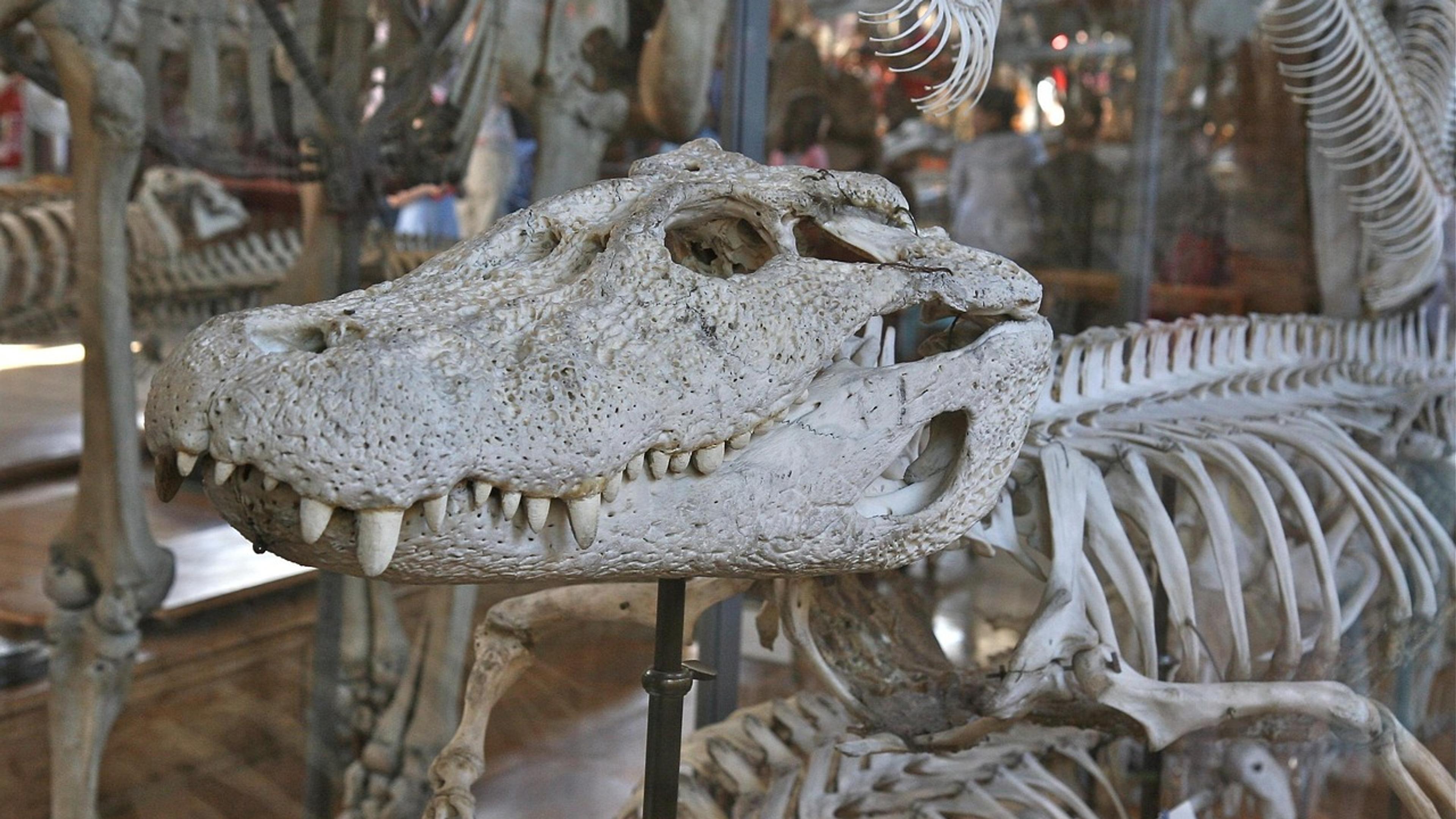
Scientists have identified a new species of ancient crocodile from 45-million-year-old fossils found in the same rock formation that the Great Sphinx of Giza was carved from, University College London said. The species, Herugavialis cairensis, is described in Royal Society Open Science.
Misidentified for almost a century
The fossils, including a nearly complete skull, were found in Egypt's Mokattam Formation in the 1920s and described in 1927. At the time they were thought to belong to the living false gharial, Tomistoma schlegelii. The skull is now kept at the State Museum of Natural History in Stuttgart.
Using CT scans to look inside the skull, a team from the UK, Sweden, Germany and Egypt found features that set it apart, including a raised ridge around the eyes.
Named after a god, missing its nose like the Sphinx
The skull is missing the tip of its snout, much as the Sphinx is missing its nose. The researchers named it after the Egyptian god Heru, who may have inspired the monument.
“Gavials are critically endangered today but they have so much history that few people know about. They lived all over the world, from Europe and the Americas to Asia.” — Dr Paul Burke, lead author, now at the Swedish Museum of Natural History
A shallow sea once covered northern Egypt
Herugavialis was a gavial, one of the long-snouted, fish-eating crocodiles. When it lived, a shallow sea covered coastal Egypt, home to at least two other gavial species. Burke said crocodile diversity in the Mediterranean region rose and fell with temperature and sea level, until the sea was cut off from the Atlantic and largely dried up about six million years ago.
Only two gavial species survive today, in South and Southeast Asia, and both are critically endangered. Fossils keep reshaping the story of life on Earth, as in a study suggesting animals evolved far earlier than thought.
Like what you're reading?
Related stories

Animals May Have Evolved Up to 200 Million Years Before the Fossil Record Shows, New Study Suggests
Exceptionally preserved Mongolian microfossils with no animals in them undercut a key argument for a late origin of animals, and molecular-clock analysis points to animal origins between 800 and 700 million years ago, Oxford-led researchers report.

NASA's TESS passes 1,000 confirmed planets as 70 new worlds join the archive in one week
NASA's Transiting Exoplanet Survey Satellite has now found more than 1,000 confirmed planets, a milestone reached as 70 new planets were added to the NASA Exoplanet Archive in a single weekly update.
Oxford chemists film the first "molecular movie" of how nature makes penicillin
Using ultrafast X-ray lasers, Oxford researchers captured atom-by-atom snapshots of the enzyme that builds penicillin's core ring, solving a decades-old puzzle that could help design new antibiotics.